How Accurate Are Snoring Apps? What the Studies Actually Show
What snoring apps actually measure
Every snoring app starts with the same raw material: sound picked up by your phone's microphone. From that, apps typically report some combination of recording time, how much of the night contained snoring, how often snoring occurred, how loud it was, and a proprietary score. These are separate quantities. A night can have a lot of quiet snoring, or a few very loud snores — and a single score blends them in a way that differs from app to app.
It helps to separate three jobs an app performs:
- Recording — capturing sound and, sometimes, saving clips. This is the easy part.
- Classification — deciding whether a sound is a snore, speech, breathing, a cough, traffic or a pet. This is where most validation research focuses.
- Loudness estimation — turning the microphone signal into a level. Without calibration, any absolute decibel value is an estimate.
From microphone to score
STEP 1
Microphone signal
Converts air pressure into numbers.
Can go wrong: Phone model, case, bedding over the mic and built-in noise processing all change the signal before any app sees it.
STEP 2
Background estimate
Learns how loud the room is without snoring.
Can go wrong: Fans, traffic and heating change the background during the night.
STEP 3
Detection
Decides whether a sound is probably a snore.
Can go wrong: Speech, heavy breathing, a partner's snoring, pets or a TV can be confused with snoring — or quiet snores missed.
STEP 4
Loudness estimate
Measures how far a detected sound rises above the background, and may estimate an absolute dB value.
Can go wrong: Without calibration, the absolute dB number is an estimate; the rise above background is more robust.
STEP 5
App score
Combines time, frequency and loudness into one number.
Can go wrong: Each app uses its own formula. Scores from different apps are not comparable.
A good result at one step does not guarantee the next. An app can detect snoring well and still report an uncalibrated decibel value, or a score that cannot be compared with any other app.
Detecting sound is not the same as identifying snoring
A microphone hears everything. Snoring is low-frequency and rhythmic, but so are some fans and heating systems. Speech, sleep-talking and heavy breathing overlap with snoring in frequency. A partner's snoring, a dog on the bed or a television in the next room can all be counted. An app's detection algorithm has to make a judgement for each sound, and it can be wrong in both directions: counting non-snores (false positives) and missing quiet or irregular snores (false negatives).
That is why validation studies compare the app with a reference — a polygraphy or polysomnography snore sensor, or a trained person listening back. Even then, the reference itself has limits, and results depend on who was studied and where.
What the validation studies show
The research base is small. The two most cited studies of consumer snoring apps tested 19 and 11 people respectively. A larger 2024 study tested three apps against in-lab polysomnography. A separate NIOSH study tested sound-level-meter apps — not snoring apps — in a laboratory.
Published validation studies
Klaus et al., 2021 (IJERPH)
SnoreLab (free version)- Question tested
- Snoring detection (share of night snoring)
- Participants
- 19 healthy adult volunteers
- Setting
- One night at home; phone 1–2 m from the pillow, microphone towards the head, sleeping alone
- Compared with
- Home polygraphy (Miniscreen plus)
- Outcome
- Share of the night spent snoring; Snore Score
- Main finding
- For people snoring more than 50% of the night: 94.7% accuracy, 100% sensitivity, 94.1% specificity. Best agreement came from the app's loud + 'epic' snoring categories.
- Limitations
- Small sample, one night, no bed partners. The app could not detect obstructive events. Its Snore Score uses an undisclosed algorithm.
Chiang et al., 2022 (Sleep & Breathing)
Snore Clock (paid)- Question tested
- Snoring detection (snoring rate)
- Participants
- 11 patients, 201 recordings
- Setting
- Home recordings on 11 phones of five brands (Asus, Apple, Sony, HTC, Xiaomi)
- Compared with
- An ENT specialist listening back to the app's recordings
- Outcome
- Snoring rate (snoring time ÷ sleep time)
- Main finding
- Snoring rates from the app correlated closely with the specialist's ratings (r = 0.907); mean detection accuracy 95%, sensitivity 78% ± 25%, specificity 97% ± 4%.
- Limitations
- The reference was human listening, not polysomnography. More false negatives at higher snoring rates. Could not tell apart snorers sharing a room. Participants aged 30–52 only.
Shiao et al., 2024 (Nature and Science of Sleep)
SnoreLab, Anti Snore Solution, Sleep Cycle- Question tested
- Snoring detection + clinical comparison with PSG
- Participants
- 60 enrolled, 52 analysed (31 with severe sleep apnea)
- Setting
- One night in a sleep centre; three identical Samsung J7 phones, one app each, 15 cm from the bed
- Compared with
- In-lab polysomnography (PSG)
- Outcome
- Recording time, snore counts, app scores vs. apnea–hypopnea index
- Main finding
- All three apps correlated with PSG recording time and snore counts; Anti Snore Solution agreed best on snore counts. Some app scores correlated with the (log) apnea–hypopnea index.
- Limitations
- Single centre; mostly correlation analyses, which the authors note do not show event-by-event agreement. Hardware and microphones can differ between phones.
Kardous & Shaw, 2014 (J. Acoust. Soc. Am.)
Sound-level-meter apps (not snoring apps)- Question tested
- Sound-level measurement (dB)
- Participants
- No participants — devices tested
- Setting
- Laboratory testing of phones and tablets
- Compared with
- Professional reference sound measurement
- Outcome
- Absolute sound level in dB and dB(A)
- Main finding
- Of 130+ iOS apps screened, 10 met the criteria; only 4 of 62 Android apps were tested. Two apps were within about 0.5 dB of the reference, two more within ±2 dB.
- Limitations
- Specific apps on specific devices in a lab. It says nothing about snoring detection and does not mean any phone app gives calibrated readings in a bedroom.
Each result applies only to the app, devices and setting tested. These studies are not a ranking of apps, and none of them tested SnapSnoreScore. Their percentages measure different outcomes against different references, so they cannot be compared with each other. Snoring detection, absolute decibel accuracy and sleep apnea diagnosis are three different questions.
How to read these results
- High accuracy for heavy snoring is not the same as high accuracy for everyone. In the SnoreLab study, accuracy figures were reported for people who snored more than half of the night; the positive predictive value at that threshold was 66.6%.
- The reference matters. Snore Clock was compared with an ENT specialist listening to the app's own recordings, not with polysomnography.
- Correlation is not agreement. The 2024 polysomnography study relied mostly on correlations; its authors note this does not show that every event was captured.
- None of these findings transfer to other apps — including SnapSnoreScore.
Absolute decibels vs. change above background
Many apps display a number like "62 dB". For that number to be an absolute sound pressure level, the phone's microphone chain would need to be calibrated against a reference meter. Phones are not shipped that way, and models differ in sensitivity, frequency response and built-in audio processing. In a NIOSH laboratory evaluation, most sound-meter apps screened did not meet the study's criteria; a handful of apps on specific devices came within about 2 dB of the reference.
A more robust measure is how far snoring rises above the room's own background, recorded by the same phone in the same place. Errors in the microphone's absolute sensitivity largely cancel out when you compare two levels from the same device. That is why a rise of "+18 dB above background" is more meaningful for night-to-night comparison than an uncalibrated "62 dB".
Our separate guide, How to Measure Snoring Decibels at Home, walks through setting this up. For typical published snoring levels and the full decibel chart, see How Many Decibels Is Snoring?
Phone, position and room change the result
The same snore can produce different readings depending on:
- The phone — microphone placement, sensitivity and any noise suppression the operating system applies.
- Distance and orientation — sound level falls with distance, and a microphone facing away or lying face-down picks up less.
- Obstruction — a phone under a pillow, in a thick case or buried in bedding is muffled.
- The room — hard walls reflect sound; curtains, carpets and bedding absorb it.
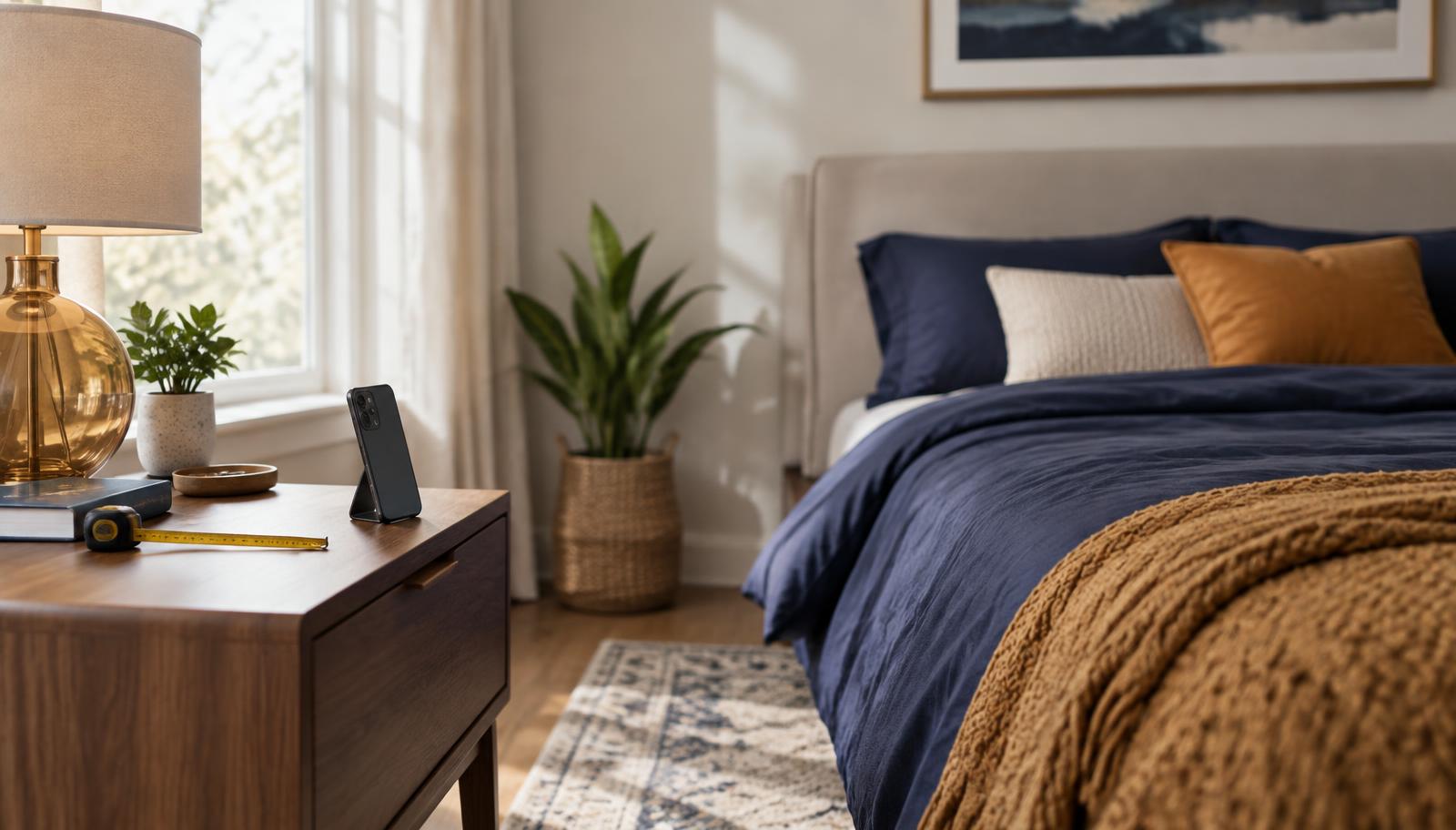
In the SnoreLab study, researchers controlled for this by asking participants to place the phone one to two metres from the pillow with the microphone towards the head, keep windows closed, and sleep without a bed partner or pet. Real homes are rarely that tidy.
Time, frequency and loudness are different things
- Recording time — how long the app ran. Not the same as sleep time.
- Snoring duration / share — how much of that time contained detected snoring.
- Snoring frequency — how many snore events per hour.
- Loudness — how loud the snores were, as a peak, an average or a rise above background.
Two nights with the same score can look very different on these measures. When comparing nights, look at the parts, not just the total.
Why snoring scores differ between apps
Snoring scores are proprietary. The SnoreLab study authors pointed out that its Snore Score is "based on an unknown algorithm" and cannot be directly compared with clinical scores. The same applies to every app's score, including ours. A score is a summary chosen by the app's designers — useful for tracking yourself on one app, not for comparing yourself with someone using a different app.
Why an app can't diagnose or rule out sleep apnea
Obstructive sleep apnea is defined by repeated narrowing or closure of the airway during sleep, measured as breathing pauses and reductions in airflow, usually with oxygen levels. A sleep study measures these directly. Snoring audio does not.
- In the SnoreLab study, obstructive events could not be detected by the app.
- In the 2024 study, some app scores correlated with apnea severity across the group — but a group-level correlation cannot tell an individual whether they have sleep apnea.
- People with sleep apnea do not always snore loudly, and many loud snorers do not have sleep apnea.
So a quiet result does not rule sleep apnea out, and a loud result does not confirm it. Read more in Snoring vs. Sleep Apnea.
Realistic expectations
Can reasonably estimate
- Record when snoring-like sounds happened during the night
- Estimate how much of the recording contained snoring
- Show how far snoring rose above the room's background
- Compare your own nights when the setup stays the same
- Give you clips to play back to a partner or clinician
Cannot establish
- Diagnose — or rule out — obstructive sleep apnea
- Measure breathing pauses or blood oxygen
- Guarantee a calibrated dB(A) value on any phone
- Reliably tell who in the room is snoring
- Make one app's score comparable with another's
Where long-term tracking can help
With the same phone, the same position and similar room conditions, an app can reasonably show direction of change: whether snoring time or loudness went down after you started sleeping on your side, avoided alcohol in the evening, or treated nasal congestion. Several nights before and after a change say more than any single night. Saved clips can also help a clinician or partner hear what the night sounded like.
When to see a doctor — whatever the app says
Speak to a doctor if you or a partner notice any of the following, regardless of any app reading:
- Pauses in breathing, gasping or choking during sleep
- Excessive daytime sleepiness, or falling asleep while driving
- Morning headaches, or waking unrefreshed despite enough time in bed
- High blood pressure alongside loud, habitual snoring
- Snoring in a child that is frequent or accompanied by breathing pauses
What SnapSnoreScore does — and doesn't
SnapSnoreScore runs in your browser. During a recording it:
- Learns your room's background level before and during the night.
- Applies A-weighting and analyses the sound in short frames as it arrives.
- Uses an adaptive detector to decide which sounds are probably snores, using their frequency content, duration and rhythm.
- Reports how far snoring rose above your room's background as the main loudness figure. An absolute dB value is shown only as an estimated range, based on the distance and room type you select.
- Calculates a 0–100 Snore Score from four parts: share of the recording with snoring (up to 40 points), events per hour (up to 25), loudness above background (up to 25) and how regular the pattern is (up to 10).
What it is not: SnapSnoreScore has not been clinically validated, and the studies above did not test it. The Snore Score is a proprietary descriptive index, not a medical score. A phone-based estimate is not interchangeable with a calibrated sound level meter, and the app cannot reliably tell whose snoring it hears.
Privacy: audio is analysed on your device and is never uploaded. Up to 12 short snore clips per recording (about 6 seconds each) may be stored in your browser for playback, until you delete them. Details are in the Privacy Policy and FAQ.
Curious how loud your snoring really is?
SnapSnoreScore uses your device's microphone to estimate snoring intensity and generate a Snore Score from 0 to 100 — entirely in your browser.
Frequently Asked Questions
Are snoring apps accurate?
Some are, for detecting snoring. In small published studies, SnoreLab (19 adults, against home polygraphy) and Snore Clock (11 patients, against an ENT specialist's review) detected snoring with high accuracy, especially heavy snoring. Those results apply only to the apps and settings tested, and neither study validated absolute decibel values or diagnosed sleep apnea.
Can a snoring app diagnose sleep apnea?
No. Sleep apnea is diagnosed with a sleep study that measures breathing, airflow and oxygen. In the SnoreLab study, the app could not detect obstructive events. Some app scores correlate with apnea severity in research, but correlation across a group does not tell an individual whether they have, or do not have, sleep apnea.
Are the decibel readings in snoring apps accurate?
Treat them as estimates. Phone microphones are not individually calibrated. A NIOSH laboratory study found a few sound-meter apps within about 2 dB of a reference on specific devices, but most apps screened did not meet its criteria, and lab results do not transfer automatically to a bedroom.
Why do two snoring apps give different scores for the same night?
Each app uses its own detection method and its own score formula, often undisclosed. A score of 40 in one app and 40 in another do not mean the same thing.
Can a snoring app tell whose snoring it is?
Generally not reliably. The Snore Clock study listed this as a limitation, and the SnoreLab study asked participants to sleep without a bed partner or pet.
Is SnapSnoreScore clinically validated?
No. SnapSnoreScore has not been tested in a published validation study, and its 0–100 Snore Score is its own descriptive index. It is not a medical device and cannot diagnose any condition.
What is a snoring app actually useful for?
Comparing your own nights with the same phone and the same setup — for example before and after changing sleeping position or avoiding alcohol — and capturing clips you can play to a partner or clinician.
Sources & further reading
This article references the following authoritative organizations and peer-reviewed sources.
- Klaus K, Stummer AL, Ruf S — Accuracy of a smartphone application measuring snoring in adults: how smart is it actually? (IJERPH, 2021)
- Chiang JK et al. — Validation of snoring detection using a smartphone app (Sleep & Breathing, 2022)
- Shiao YH, Yu CC, Yeh YC — Validation of downloadable mobile snore applications by polysomnography (Nature and Science of Sleep, 2024)
- Kardous CA, Shaw PB — Evaluation of smartphone sound measurement applications (J. Acoust. Soc. Am., 2014)
- Wilson K et al. — The snoring spectrum: acoustic assessment of snoring sound intensity in 1,139 individuals (Chest, 1999)