How to Measure Snoring Decibels at Home (and Read the Number)
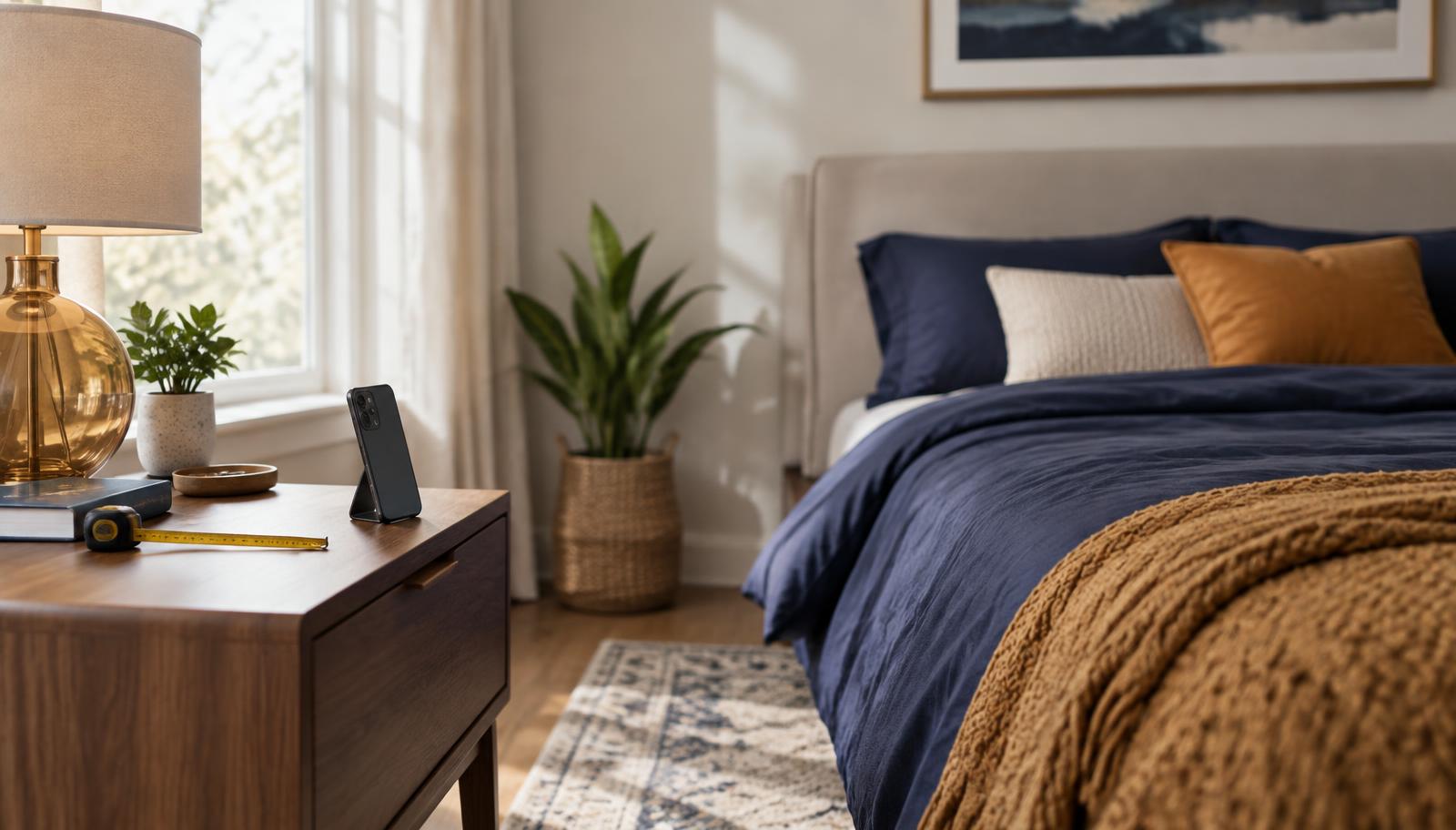
Start with the goal: a repeatable measurement
A phone will happily display "57.3 dB". That decimal point suggests a precision the measurement doesn't have. What a home measurement can do well is tell you whether snoring changed between nights — provided the setup stays the same. Everything in this guide aims at making tonight's recording comparable with next week's.
If you want to know what typical snoring levels are, our snoring decibel chart covers that. This guide is about doing and interpreting your own measurement.
Prepare the room
- Reduce variable noise. Fans, air purifiers, white-noise machines and TVs raise the background and can be mistaken for snoring. Turn them off — or, if you need them, keep them on the same setting every night.
- Close windows if you can. Traffic and wind change from night to night.
- Note unusual nights. A storm, guests, a cold or a different bed all change the result.
- Pets and partners. A phone can't reliably tell whose snoring it hears. If someone else in the room snores, interpret the result with that in mind.
Choose one phone position — and keep it
Pick a spot you can repeat exactly: the same side of the bed, the same nightstand, the same distance. About one metre from your head works for most bedrooms; a published SnoreLab study asked participants to place the phone 1–2 m from the pillow with the microphone towards the head.
- Orientation: point the microphone end (usually the bottom edge) towards the pillow.
- Don't muffle it: no pillow, duvet or case flap over the microphone, and not face-down in soft bedding.
- Avoid surfaces that buzz or reflect: not pressed against a wall, a headboard or next to a humming charger.
Setup diagram
- Not under pillows or the duvet
- Not pressed against a wall or headboard
- Away from a fan or buzzing charger
Top-down view, not to scale. The exact distance matters less than using the same one each night. Note it down — for example, 'nightstand, left side, 1 m, mic towards the pillow'.
Record the background first
The background level is the sound of your room with nobody snoring: ventilation, distant traffic, the fridge in the next room. It is the reference everything else is measured against. A good measurement app samples this before you fall asleep and keeps tracking it during the night, because it changes.
Measuring snoring as a rise above background has a practical advantage: any error in your phone's absolute sensitivity affects both levels similarly, so it largely cancels out when you compare them on the same device.
Peak, average and background
A single "snoring dB" number can mean very different things:
- Peak — the loudest moment. Easy to understand but sensitive to distance, a single cough, or the phone being bumped.
- Average over the night — mixes snoring with silence. A night with a few loud snores and a lot of quiet can have a low average.
- Typical snore above background — how loud snores usually were compared with your room. Usually the most useful for comparison.
Hypothetical readings
Background
The room without snoring. Your reference point.
Average
Depends heavily on how much silence is included.
Peak
The loudest moment. Very sensitive to distance and one-off noises.
Invented numbers on an uncalibrated relative scale, for illustration only. The background stays near the bottom; snores show as short spikes. A night 'average' mixes quiet gaps with snores, so it sits far below the peaks — and neither tells you how often snoring happened.
Published research uses different summaries too. A large sleep-lab study (Wilson et al., 1999) reported snoring as A-weighted percentiles — how much of the night exceeded a level — rather than a single peak. That's one reason published numbers vary.
dB and dB(A)
dB on its own is a logarithmic ratio: every +10 dB is ten times the sound power and, roughly, a doubling of perceived loudness. dB(A) applies A-weighting, a filter that turns down very low and very high frequencies to approximate human hearing. Snoring has a lot of low-frequency energy, so its dB and dB(A) values can differ. Sleep research and noise guidelines usually report dB(A); many apps don't say which they show.
Why your phone isn't a sound level meter
A sound level meter is built and calibrated to measure absolute sound pressure to a standard. A phone's microphone is designed for speech, and phones differ in sensitivity, frequency response and the audio processing the operating system applies. In a NIOSH laboratory evaluation, only 10 of more than 130 iOS sound-meter apps met the study's selection criteria, and only 4 of 62 Android apps were tested; a few apps on specific devices came within about 2 dB of the reference. That's encouraging for those apps in a lab — it doesn't mean any given phone gives calibrated dB(A) readings in a bedroom.
For snoring apps specifically, see How Accurate Are Snoring Apps?
Rooms, reflections and the 6 dB rule
You may have read that sound drops by about 6 dB each time the distance doubles. That's the inverse-square law for a point source in free field — open space with no reflections. A bedroom isn't free field. Walls, ceiling and floor reflect sound back; bedding, curtains and carpets absorb it. Close to the sleeper the direct sound dominates; further away, reflected sound makes up more of what the microphone hears, so the drop with distance is usually smaller and less predictable than 6 dB.
Room size matters too: in a small, hard-surfaced room, snoring can read louder than the same snore in a large, furnished one. The practical conclusion is the same as before: fix the position, and compare like with like.
Measurement uncertainty
Measurement uncertainty
Phone microphone
Not individually calibrated; sensitivity and frequency response differ between models.
Distance
In open space, level drops about 6 dB per doubling of distance. In a bedroom, reflections make the real change smaller and less predictable.
Room
Walls, bedding, curtains and room size absorb or reflect sound differently.
Software
Built-in noise suppression, weighting (dB vs dB(A)) and averaging windows change the number.
Night-to-night variation
Snoring itself varies with sleep position, alcohol, congestion and sleep stage.
Because these errors are similar from night to night when the setup is fixed, comparing your own nights is far more reliable than comparing your number with someone else's.
Checklist
- Charge the phone, or plug it in for the night
- Same spot, same distance (about 1 m), microphone end towards the pillow
- Nothing covering the phone — no pillow, duvet or thick case flap
- Turn off or fix noise sources: fan, TV, white-noise machine — or keep them identical every night
- Close windows if you can; note anything unusual (storm, guests, a cold)
- Let the app measure the room's background before you fall asleep
- Record the whole night, ideally three or more nights before drawing conclusions
- Write down lifestyle factors (alcohol, sleeping position, congestion) for each night
Comparing results across nights
Snoring varies with sleeping position, alcohol, congestion, tiredness and sleep stage, so one night is a snapshot. Record three or more nights with the same setup before drawing conclusions, and log what was different about each night. When testing a change — side sleeping, nasal strips, no alcohol after dinner — record several nights before and after.
Worked example — hypothetical
| Night | Background | Rise above it | Time snoring | Reading |
|---|---|---|---|---|
| Night 1 — usual | 30 | +18 dB | 22% | Baseline |
| Night 2 — after alcohol | 31 | +24 dB | 38% | More, and louder |
| Night 3 — fan on | 39 | +11 dB | 15% | Not comparable: background changed |
| Night 4 — side sleeping | 30 | +12 dB | 9% | Less snoring, same setup |
All values are invented to show the reasoning. 'Rise' is the typical snore level above that night's background, in dB. Night 3 looks quieter, but the fan raised the background, so its rise and detection cannot be compared with the others.
Look at the parts separately: how much of the night contained snoring, how often it occurred and how far it rose above the background. If the background itself changed a lot, that night isn't a fair comparison.
The limits of a single number
A loudness figure — or a 0–100 score — compresses a whole night into one value. It can't tell you what kind of snoring it was, whether breathing paused, or how well you slept. Use it to compare your own nights, and listen to a few saved clips for context.
What loudness can't tell you about sleep apnea
There is no validated decibel threshold that diagnoses or rules out obstructive sleep apnea. Louder snoring is associated with more disturbed breathing on average in sleep-lab research, but some people with sleep apnea snore softly, and many loud snorers don't have it. Sleep apnea is assessed with a sleep study that measures breathing and oxygen directly.
Talk to a doctor if you or a partner notice breathing pauses, gasping or choking, excessive daytime sleepiness, or morning headaches — whatever your recording shows. More in Snoring vs. Sleep Apnea.
Privacy, saved clips and deletion
Before using any recording app, check what it keeps and where. In SnapSnoreScore, audio is analysed in your browser as it arrives and is never uploaded. Up to 12 short snore clips of about 6 seconds per recording may be stored on your device for playback. They remain after you close the browser until you delete them from the report, clear your history, or clear the site's data. See the Privacy Policy and FAQ.
Measuring with SnapSnoreScore
The overnight measurement asks for your phone's distance and room type, measures the background, and reports snoring primarily as a rise above your room's background, with any absolute dB shown only as an estimated range. Its 0–100 Snore Score is a proprietary descriptive index — see how it's built — and has not been clinically validated. To look up what a particular level sounds like, use the loudness database.
Curious how loud your snoring really is?
SnapSnoreScore uses your device's microphone to estimate snoring intensity and generate a Snore Score from 0 to 100 — entirely in your browser.
Frequently Asked Questions
Can I measure snoring decibels with my phone?
You can estimate them. Phone microphones are not calibrated sound level meters, so an absolute dB value is approximate. Measuring how far snoring rises above your room's background, with the same phone in the same place, is more reliable for comparing nights.
How far should the phone be from my head?
About one metre is a practical choice, and similar to the 1–2 m used in a published SnoreLab study. What matters most is using the same distance and position every night.
Should I use peak or average decibels?
Look at both, plus how much of the night contained snoring. Peaks are sensitive to distance and one-off noises; averages depend on how much silence is included. Neither tells you how often you snored.
What is the difference between dB and dB(A)?
dB(A) applies a frequency weighting that approximates human hearing, reducing very low and very high frequencies. Sleep research and noise guidelines usually use dB(A). Many apps show unweighted or uncalibrated 'dB', so numbers from different sources may not match.
Does moving the phone twice as far away lower the reading by 6 dB?
Only in idealised open space. In a bedroom, walls, furniture and bedding reflect and absorb sound, so the change is usually smaller and less predictable. That is another reason to keep the distance fixed.
How many nights should I measure?
Snoring varies from night to night. Three or more nights with the same setup give a better picture than one, especially before and after a change such as side sleeping.
Is there a decibel level that means I need to see a doctor?
No validated decibel threshold diagnoses sleep apnea or any other condition. See a doctor if you have symptoms such as breathing pauses, gasping, or daytime sleepiness, whatever the reading.
Sources & further reading
This article references the following authoritative organizations and peer-reviewed sources.
- Kardous CA, Shaw PB — Evaluation of smartphone sound measurement applications (J. Acoust. Soc. Am., 2014)
- Klaus K, Stummer AL, Ruf S — Accuracy of a smartphone application measuring snoring in adults (IJERPH, 2021)
- Wilson K et al. — The snoring spectrum: acoustic assessment of snoring sound intensity in 1,139 individuals (Chest, 1999)
- WHO — Night Noise Guidelines for Europe