How Many Decibels Is Snoring? Average dB Levels (30–90 dB)
We all know that snoring can be loud. But how many decibels is snoring, exactly? When we talk about sound intensity, we use a unit called the decibel (dB) — and snoring covers a surprisingly wide range on that scale. Understanding where your snoring falls on the decibel spectrum can give you important insight into your sleep health and whether your nightly noise is cause for concern.
In this article, we'll break down the decibel scale, explain where different levels of snoring fall on it, compare snoring to familiar everyday sounds, and show you how to measure your own snoring volume from the comfort of your bedroom.
Snoring Loudness Database: 10 dB to 100 dB
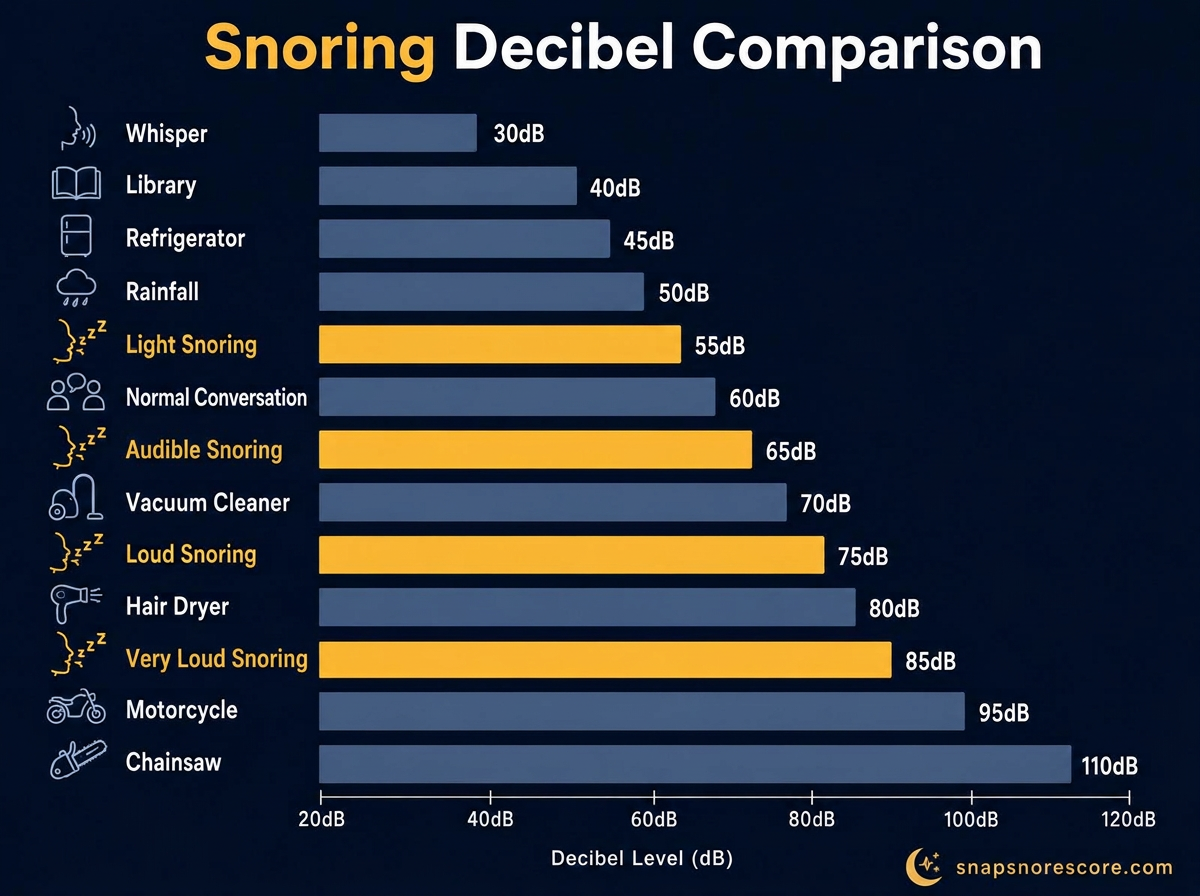
This is the reference table we built for the single most common question about snoring: what does this decibel number actually mean? Every level from 10 dB to 100 dB is listed with the everyday sound it matches, how that snore is described and its acoustic context. The tiers are editorial descriptions of sound, not medical categories. Toggle the table to 5 dB steps for in-between levels such as 45 dB, 55 dB or 85 dB.
All levels in 5 dB steps — 10 dB to 100 dB
| Level | Equivalent sound | How it sounds | What it means | Acoustic context |
|---|---|---|---|---|
| 10 dBBarely audible | Normal breathing, rustling leaves | Almost silent — only measurable, not hearable | Not snoring. Quiet breathing sounds only. | Below the background level of most bedrooms. |
| 15 dBBarely audible | A ticking wristwatch across the room | A faint air movement you have to listen for | Below the snoring threshold. | Below the background level of most bedrooms. |
| 20 dBBarely audible | A whisper at close range | Soft nasal breathing with a slight rasp | Pre-snoring airflow noise. | Around the background level of a very quiet room. |
| 25 dBBarely audible | A quiet bedroom at night | A faint purr on the inhale | The lowest level most people would still call snoring. | Typical assumed bedroom background level. |
| 30 dBAudible | A quiet rural area, a soft library | A gentle, rhythmic purr | Audible snoring, rarely noticed by a partner. | Roughly 5 dB above a quiet bedroom background. |
| 35 dBAudible | A whispered conversation | A soft, steady rumble | Audible snoring — level often changes with position. | About 10 dB above a quiet bedroom background. |
| 40 dBAudible | A quiet office, a refrigerator hum | Clearly audible rumble from the next pillow | Clearly audible across the bed. | Roughly twice as loud as a 30 dB(A) sound. |
| 45 dBAudible | Light rain, a quiet suburb | A continuous rumble with occasional catches | Clearly audible across the room. | Near the WHO night noise guideline for bedrooms. |
| 50 dBAudible | Moderate rainfall, a quiet conversation | A full, even snore audible across the bedroom | Around the commonly reported adult snoring average. | About four times as loud as 30 dB(A). |
| 55 dBAudible | A running dishwasher, a coffee machine | A loud rumble with clear peaks on each breath | Above this level snoring is reliably noticed by a bed partner. | Above typical bedroom noise guidelines. |
| 60 dBLoud | Normal conversation at arm's length | A heavy, throaty snore heard through a closed door | Conversation-level loudness. | Carries beyond the room through an open door. |
| 65 dBLoud | A restaurant at dinner time, a loud TV | Rasping, uneven snoring | Louder than ordinary conversation. | Commonly reported as sleep-disturbing for a partner. |
| 70 dBLoud | A shower, a vacuum in the next room, busy traffic | Rattling, sawing snore that fills the room | The level usually described as loud snoring. | Roughly the level of daytime street traffic. |
| 75 dBLoud | A vacuum cleaner at 3 m | Harsh, uneven snore with obvious effort | Very loud. Bed partners commonly sleep elsewhere. | About twice as loud as 65 dB(A). |
| 80 dBVery loud | A garbage disposal, a food blender | Explosive snorts between long rumbles | Very loud — audible through a closed door. | Around the level of a busy urban street. |
| 85 dBVery loud | Heavy city traffic, a hair dryer | Room-shaking snore | Extremely loud for a bedroom. | Occupational noise guidelines flag sustained exposure here. |
| 90 dBExtreme | A lawnmower, a motorcycle passing | Very loud snore heard through walls | Near the top of the reported human range. | Rarely measured outside record attempts. |
| 95 dBExtreme | A subway train, a power drill | Guttural roar with long silent gaps | Extremely rare in reported measurements. | Rarely measured outside record attempts. |
| 100 dBExtreme | A chainsaw, a nightclub speaker | Overwhelming, unmistakable roar | Record territory — the loudest snore ever verified was 111.6 dB. | Documented only in record measurements. |
What a snoring decibel number does not mean
A higher snoring volume does not automatically mean a more serious sleep disorder. Decibels describe how loud a sound is — they say nothing on their own about breathing pauses, oxygen levels or sleep quality. Quiet snoring can accompany significant obstructive sleep apnea, and loud snoring can occur in people with no sleep disorder at all.
- Loudness ≠ sleep quality. A 70 dB snore says how much noise reached the microphone, not how well you slept.
- Loudness ≠ sleep apnea. Apnea is defined by pauses in breathing, not by volume. No decibel threshold can confirm or rule it out.
- Numbers move for non-medical reasons. Phone distance, room acoustics, sleeping position, alcohol, congestion and a blocked microphone can each shift a reading by 5–10 dB.
- Symptoms matter more than the number. Witnessed breathing pauses, gasping or choking at night, and heavy daytime sleepiness are the reasons to speak to a doctor — not a specific dB value.
SnapSnoreScore measures and explains sound. Deciding whether snoring is a medical problem requires a clinician, who can look at symptoms and, when appropriate, a sleep study. See our medical disclaimer.
Two caveats when reading any decibel figure: the number depends on distance (a snore measured at the pillow is roughly 6 dB louder than the same snore measured 2 m away) and on peak vs. average — a snore averaging 50 dB can still peak above 70 dB. Studies use different conventions (see below), so treat every row as an approximate reference.
How Snoring Is Measured in Studies
The largest classic dataset is Wilson et al. (Chest, 1999): 1,139 patients referred to a sleep laboratory, with snoring sound recorded during polysomnography. Loudness was reported in A-weighted decibels, dB(A), as percentiles — L1, L5 and L10 (the level exceeded for 1%, 5% and 10% of the night) — and as Leq, the energy-average over the whole test. Only 12.3% of patients had an L10 above 55 dB(A). Men snored louder than women on average, and louder snoring was associated with higher respiratory disturbance index, body mass and reported symptoms.
Two things follow. First, this was a referred sleep-clinic population, not the general public. Second, a night-average (Leq) and a loudest-moment figure (peak or L1) can differ by 20 dB or more for the same person. That is the main reason published 'average snoring' figures disagree.
dB vs dB(A)
Plain dB describes sound pressure across all frequencies. dB(A) applies A-weighting, which turns down low and very high frequencies to approximate human hearing. Snoring has a lot of low-frequency energy, so unweighted and A-weighted readings of the same snore can differ. Noise guidelines (WHO, OSHA) and most snoring studies use dB(A).
Peak vs average
A snore that 'measures 75 dB' may be the single loudest moment of the night. The same night may average 40–45 dB once quiet breathing and silence are included. When comparing numbers, always ask which one is being reported.
Microphone distance
In open space, sound level drops roughly 6 dB each time the distance doubles. A phone 25 cm from the mouth can read about 12 dB higher than one 1 m away. In a bedroom, reflections from walls reduce this effect somewhat, but distance remains the biggest source of disagreement between readings.
Absolute dB vs rise above background
A phone microphone is not a calibrated sound level meter: sensitivity varies between models, and operating-system processing can change levels. A relative measurement — how far snoring rises above the room's own measured background — is much more robust than an absolute dB claim. That is why SnapSnoreScore leads with the rise above background and shows absolute dB only as an estimated range.
Understanding the Decibel Scale
The decibel scale measures sound intensity, and it's logarithmic rather than linear. A 10 dB increase means 10 times the sound intensity and is perceived as roughly twice as loud. A 20 dB increase means 100 times the intensity. This is important context for understanding snoring levels, because even small changes in decibels represent significant differences in actual loudness.
For reference, here are some common sound levels that most people can relate to:
- 10 dB — Breathing, rustling leaves
- 20 dB — Whispering at close range
- 30 dB — A quiet rural area at night
- 40 dB — A library, quiet office
- 50 dB — Moderate rainfall, a quiet conversation
- 60 dB — Normal conversation at arm's length
- 70 dB — A shower, dishwasher, or busy traffic
- 80 dB — A vacuum cleaner or alarm clock
- 90 dB — A lawnmower or motorcycle
- 100 dB — A chainsaw or nightclub
With this context in mind, let's see where snoring fits into the picture.
How Loud Is Snoring, Really?
Snoring volume varies enormously from person to person and even from night to night. Research published in sleep medicine journals has documented a wide range of snoring sound levels, and the results might surprise you.
The ranges below are editorial, acoustic descriptions — how loud the sound is — not clinically validated categories. They assume a measurement around 1 m from the sleeper.
Light Snoring: 30–45 dB
Comparable to a whisper or a quiet room. Often unnoticed by anyone not lying right next to you, and frequently linked to position or a blocked nose. Read more about why people snore.
Audible Snoring: 45–60 dB
Comparable to moderate rainfall or a normal conversation. Clearly audible to a bed partner and the range many consumer sources describe as typical.

Loud Snoring: 60–80 dB
Comparable to a vacuum cleaner or busy street. Audible through doors and usually disruptive for anyone in the room. See 60 dB, 70 dB and 80 dB snoring.
Very Loud Snoring: 80+ dB
Comparable to a lawnmower or garbage disposal. Rare, and usually a peak measured close to the sleeper. The Guinness World Record for the loudest snore is 111.6 dB. See 90 dB snoring.
How Snoring Compares to Everyday Sounds
To put snoring volume into everyday perspective, here's how different snoring levels compare to sounds you encounter regularly:
- Quiet snorer (35 dB) — About as loud as a whispered conversation. Barely noticeable.
- Average snorer (50 dB) — Similar to moderate rainfall or a quiet suburban street. Noticeable to a bed partner.
- Loud snorer (65 dB) — Comparable to a running dishwasher or a conversation in a restaurant. Audible through a closed door.
- Very loud snorer (80 dB) — As loud as a food blender. Can wake people in adjacent rooms.
- Extreme snorer (90+ dB) — Like sleeping next to a lawnmower. Affects everyone in the household.
Curious how loud your snoring really is?
SnapSnoreScore uses your device's microphone to estimate snoring intensity and generate a Snore Score from 0 to 100 — entirely in your browser.
What Affects Snoring Volume?
Several factors influence how loud your snoring gets on any given night. Understanding these variables can help you identify patterns and take steps to reduce your snoring volume.
- Sleeping position: Back sleeping almost always produces louder snoring than side sleeping, because gravity causes the tongue and soft palate to fall backward toward the airway. See our guide on the best sleeping position for snoring.
- Alcohol consumption: Drinking alcohol before bed relaxes the throat muscles beyond their normal resting state, increasing both the likelihood and volume of snoring.
- Body weight: Excess weight, particularly around the neck, puts additional pressure on the airway and increases snoring volume. In the Wilson et al. sleep-lab study, body mass was associated with snoring intensity.
- Nasal congestion: A blocked nose forces mouth breathing, which tends to produce louder snoring than nasal breathing. Seasonal allergies, colds, and sinus issues can all temporarily increase snoring volume.
- Sleep stage: Snoring varies across the night and between sleep stages, so a single moment is a poor summary of a whole night.
- Fatigue and sleep deprivation: When you're overtired, your muscles relax more deeply during sleep, which can amplify snoring. Ironically, poor sleep from snoring can create a cycle of increased fatigue and even louder snoring.
How to Measure Your Snoring Volume
For a step-by-step setup — phone position, background level, peak vs average and comparing nights — see How to Measure Snoring Decibels at Home. For what published studies say about app reliability, read How Accurate Are Snoring Apps?
Sleep laboratories measure snoring with calibrated microphones alongside breathing sensors. At home, a phone can give useful information about when and how much you snore, and how much it rises above your room's background — with important limits on absolute dB.
SnapSnoreScore analyses your microphone signal in the browser with A-weighting, measures your room's background level, and detects snore-like events. Its report leads with how far snoring rises above that background, plus timing facts (snoring time, events per hour). The 0–100 Snore Index is SnapSnoreScore's own summary of the night — it is not clinically validated and does not assess sleep apnea.
All analysis happens on your device; audio is never uploaded. Optional short snore clips are stored only on your device so you can listen back, and you can delete them anytime. For the best reading, place the phone about 1 m from your head, keep it plugged in, and leave fans or other noise sources at the same setting all night.
Tracking your snoring volume over time can reveal important trends. You might discover that your snoring is significantly louder on certain nights — perhaps after drinking wine, sleeping on your back, or during allergy season. These patterns can guide you toward effective, targeted solutions. Check out our 7 natural methods to stop snoring for actionable advice, or see our snoring measurement FAQ for how the dB estimate is calculated.
How accurate are phone apps? Validation studies exist for specific apps only. Klaus et al. (2021) compared the free SnoreLab app with home polygraphy in 19 adults and found acceptable accuracy for nights with heavy snoring, but the app could not detect obstructive breathing events. Chiang et al. (2022) found that Snore Clock's snoring detection correlated closely with expert review of its recordings (11 patients, 201 records). These results do not transfer to other apps — including SnapSnoreScore, which has not been clinically validated.
Want the answer for one specific level? Our snoring loudness explorer breaks down each decibel step with sound comparisons — for example is 45 dB snoring loud?, 65 dB snoring, and 90 dB snoring.
What Loudness Can — and Can't — Tell You About Sleep Apnea
In sleep-lab research, louder snoring is associated with more disturbed breathing on average. Wilson et al. reported, for example, that men with a BMI above 30 and an average snoring level above 38 dB(A) were 4.1 times more likely to have a respiratory disturbance index above 10. But associations across a group do not make a threshold for an individual: many loud snorers do not have sleep apnea, and some people with sleep apnea snore softly or irregularly.
That is why no decibel number can rule sleep apnea in or out. The signs doctors ask about are witnessed pauses in breathing, gasping or choking at night, unrefreshing sleep, daytime sleepiness, morning headaches and high blood pressure. If those apply to you, talk to a doctor — at any loudness. Learn more in snoring vs. sleep apnea and is snoring dangerous?.
What loudness does tell you reliably is acoustic: how disruptive the sound is for the room, and whether changes like side sleeping or skipping alcohol make your snoring quieter over several nights measured the same way.
For a comprehensive overview of everything snoring — from causes and health risks to treatments and tracking — see our complete guide to snoring.
Key Takeaways
Snoring volume spans an enormous range — from barely audible at 30 dB to louder than a lawnmower at 90+ dB. Published figures vary mainly because of distance, weighting and peak-vs-average conventions.
Measuring your snoring is easier than ever with modern browser-based tools. By understanding your snoring volume and tracking it over time, you can identify triggers, measure the impact of lifestyle changes, and see whether changes make a difference. For questions about breathing during sleep, a doctor and a sleep study are the right tools. Whether you're a quiet whisper-snorer or a room-shaking rumbler, knowledge is the first step toward better sleep.
Frequently Asked Questions
How many decibels is snoring?
Most sources put everyday snoring at roughly 40–60 dB, about the level of a quiet-to-normal conversation. Loud snoring can reach 70–90 dB at close range. The Guinness World Record is 111.6 dB. Published figures vary because studies measure at different distances and report peaks, percentiles or night averages.
How many dB is loud snoring?
Snoring around 70 dB and above is usually described as loud — comparable to a vacuum cleaner or busy traffic. This is an acoustic description, not a medical category.
What is the average snoring decibel level?
There is no single agreed average. In a sleep-lab study of 1,139 patients (Wilson et al., Chest 1999), snoring was measured in A-weighted decibels and summarised as percentiles; only 12.3% of patients exceeded 55 dB(A) for 10% of the night. Consumer sources often quote 50–60 dB, usually for peaks measured near the sleeper.
Is 70 decibels of snoring loud?
Yes — 70 dB is comparable to a shower running or a vacuum cleaner in the next room, and is above the averages most sources report. It is loud enough to disturb a bed partner.
Can snoring be as loud as 90 decibels?
Yes, though it is rare and usually a peak measured close to the sleeper. 90 dB is comparable to a lawnmower.
What is the difference between dB and dB(A)?
dB(A) applies A-weighting, which reduces low and very high frequencies to approximate how human hearing perceives loudness. Sleep studies and noise guidelines usually report dB(A); many apps show unweighted or uncalibrated 'dB'.
Why does distance change a snoring dB reading?
Sound level falls as you move away from the source — roughly 6 dB each time the distance doubles in open space. A phone on the pillow can read noticeably higher than one on the nightstand.
How accurate are snoring apps?
Studies have tested specific apps for detecting snoring (for example SnoreLab against home polygraphy, and Snore Clock against expert review), with reasonable accuracy for heavy snoring. Those results apply only to the apps tested, and none of them diagnosed sleep apnea. Phone microphones are also not calibrated sound meters, so absolute dB values are estimates.
Is there a decibel level that means sleep apnea?
No. Louder snoring is associated with more disturbed breathing on average in sleep-lab research, but loud snorers may not have sleep apnea and some people with sleep apnea snore softly. Only a sleep study can assess it.
How do I measure my snoring volume?
Place your phone at a fixed distance (about 1 m) from your head, keep the room quiet, and record the whole night. SnapSnoreScore measures how far sound rises above your room's own background level and shows absolute dB only as an estimated range.
Sources & further reading
This article references the following authoritative organizations and peer-reviewed sources.
- CDC — What noises cause hearing loss?
- Sleep Foundation — Snoring volume
- Guinness World Records — Loudest snore
- WHO — Night Noise Guidelines for Europe
- NIDCD — Noise-induced hearing loss
- Wilson K et al. — The snoring spectrum: acoustic assessment of snoring sound intensity in 1,139 individuals (Chest, 1999)
- Klaus K et al. — Accuracy of a smartphone application measuring snoring in adults (IJERPH, 2021)
- Chiang JK et al. — Validation of snoring detection using a smartphone app (Sleep Breath, 2022)
Related Articles
How to Measure Snoring Decibels at Home (and Read the Number)
How Accurate Are Snoring Apps? What the Studies Actually Show
The Complete Guide to Snoring: Causes, Risks, Solutions & How to Track It
Why Do People Snore? Causes, Myths, and What It Means
Is Snoring Dangerous? When You Should Be Concerned
Snoring vs Sleep Apnea: What's the Difference?
Best Sleeping Position To Stop Snoring (Backed by Science)