Is 80 dB Snoring Loud?
80 dB snoring is very loud — comparable to a garbage disposal or heavy city traffic from up close. It is near the upper end of what is usually measured.
What does 80 dB actually sound like?
80 dB is roughly the same loudness as these everyday sounds:
- ▸A garbage disposal (80 dB)
- ▸A blender (80 dB)
- ▸City traffic from inside a car (80 dB)
- ▸A ringing alarm clock (80 dB)
Decibels are logarithmic: every +10 dB is roughly twice as loud to the human ear.
What it's like for your bed partner
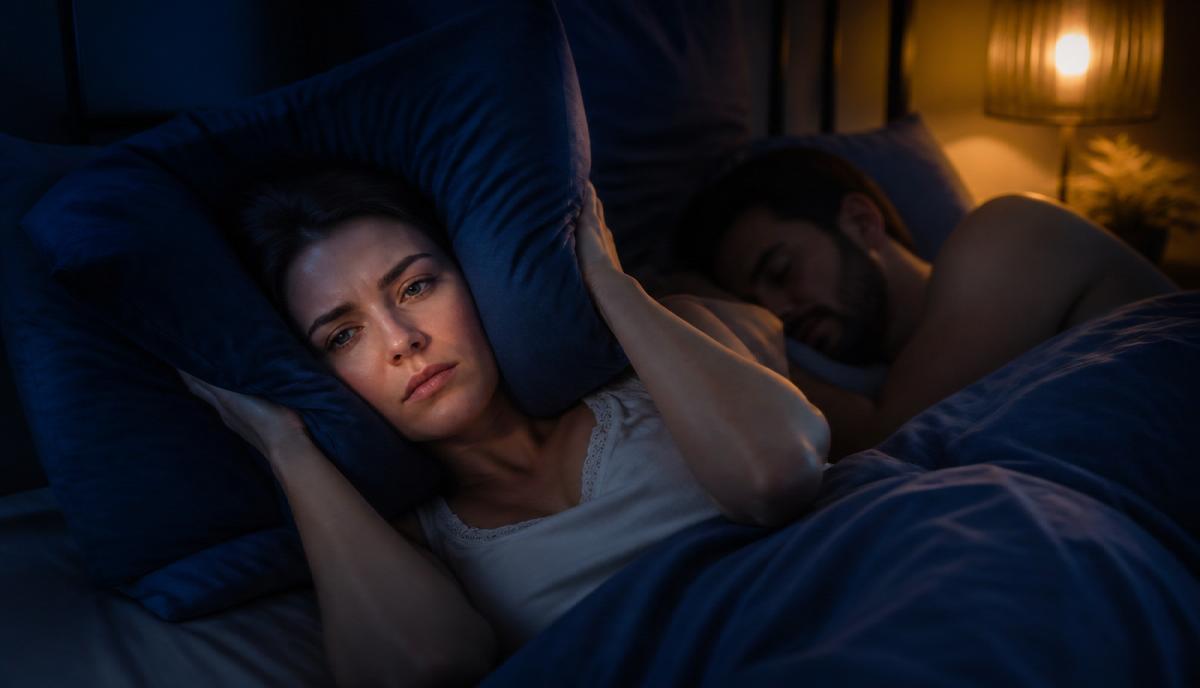
80 dB snoring is audible through a closed door, and many partners end up sleeping in another room or using earplugs.
Drag to find your snoring's twin
Move the slider through the decibel range and see which everyday sound matches your snoring — and where you fit compared to other adults.
Your snoring sounds like
Garbage disposal (80 dB)
Very loud
Comparable to city traffic heard from the pavement.
Compared to reported averages
In the range usually described as loud snoring
Literature typically describes snoring from about 70 dB upward as loud.
We don't publish a percentile ranking — we have no measured dataset of adult snorers to base one on.
Everyday sound ladder
- 🤫Whisper20 dB
- 📚Quiet library30 dB
- ❄️Refrigerator hum45 dB
- 🌦️Light rain55 dB
- 💬Normal conversation60 dB
- 🧹Vacuum cleaner70 dB
- 🌀Garbage disposal80 dB
- 🚜Lawnmower90 dB
- 🏍️Motorcycle100 dB
- 🏆Chainsaw (world record)111 dB
Educational comparison — not a medical diagnosis. Persistent loud snoring should be discussed with a clinician.
Snoring decibel chart
Where 80 dB sits in the full range of snoring loudness — highlighted row below.
| Decibels | Snoring level | Sounds like | Impact on your partner | Acoustic level |
|---|---|---|---|---|
| 40–49 dB | Very light | Quiet library, soft rainfall | Barely noticed by most partners | Quiet |
| 50–59 dB | Light / social | Soft conversation, refrigerator hum | Background noise — light sleepers may stir | Quiet |
| 60–64 dB | Conversation-level | Normal conversation, dishwasher | Regularly disrupts a partner in the same bed | Audible |
| 65–74 dB | Loud | Vacuum cleaner, busy restaurant | Hard to sleep through without earplugs | Audible |
| 75–84 dB | Very loud | City traffic, garbage disposal | Audible through a closed bedroom door | Very loud |
| 85–94 dB | Extreme | Lawnmower, motorcycle at 8 m | Partner usually moves to another room | Extreme |
| 95+ dB | Record territory | Chainsaw, jackhammer | Heard from other floors of the house | Extreme |
Decibel ranges are measured roughly 1 metre from the sleeper. These are acoustic descriptions of sound only — loudness on its own cannot indicate a medical condition.
What 80 dB can — and can't — tell you
Louder snoring is associated with sleep-disordered breathing on average in sleep-lab studies, but no decibel value diagnoses obstructive sleep apnea. Check the reading first (phone distance, peak vs average). If very loud snoring is habitual — especially with witnessed pauses or daytime sleepiness — mention it to a doctor.
How to read any snoring dB number
A reading depends on microphone distance (halving the distance adds roughly 6 dB), on whether it is a peak or a night average, and on the device's calibration. No fixed decibel value is a medical threshold for sleep apnea — that can only be assessed with a sleep study. See how snoring is measured in studies.
Build your snoring self-report profile
Loudness is only one dimension. Six quick questions describe frequency, partner disruption and reported symptoms — a profile for your own notes, not a clinical score.
How severe is your snoring?
A free self-check score that combines your own estimates of loudness, frequency, and symptoms into a single 0–100 number. Takes under a minute. No sign-up.
This is SnapSnoreScore's own self-check model — not a validated clinical instrument such as STOP-BANG or the Epworth Sleepiness Scale, and not a diagnosis.
No result yet
Complete the questions to see your result
We don't show a score until you've answered every question yourself — a default score would not be your result.
- Estimated peak loudness
- Nights per week you snore
- Partner / household impact
- Daytime sleepiness
3 of 4 questions left.
Self-check score from your own answers — not a validated clinical screening tool and not a diagnosis. See our disclaimer.
Measure your actual snoring tonight
Guessing your dB level is one thing. Recording your actual snoring gives you a real number — for free, with 100% local processing.
Frequently Asked Questions
Is 80 dB snoring the same as sleep apnea?+
No — loudness alone doesn't diagnose sleep apnea. Louder snoring is more common in people with disturbed breathing on average, but many loud snorers don't have it. A sleep study is the only way to assess it.
How loud is 80 dB in everyday terms?+
80 dB is about the loudness of a garbage disposal, blender, or busy city traffic heard from inside a car. It's loud enough to interfere with a normal conversation.
Can 80 dB snoring cause hearing damage to a partner?+
Occupational limits are based on sustained 8-hour averages around 85 dB(A); intermittent snoring averages far lower than its peaks. Hearing loss is unlikely, but sleep disruption is real.
What's the loudest snoring ever recorded?+
The Guinness World Record for the loudest snore is 111.6 dB, set by Kåre Walkert of Sweden.
Compare other decibel levels
Is 50 dB Snoring Loud?
50 dB snoring is on the quiet end — about the level of a soft conversation or a quiet subu…
Is 90 dB Snoring Loud?
90 dB snoring is extremely loud — comparable to a lawnmower or a hair dryer at close range…
Is 100 dB Snoring Loud?
100 dB snoring is extraordinarily loud — comparable to a motorcycle or a chainsaw from a d…
Is 60 dB Snoring Loud?
60 dB snoring is moderate — about as loud as a normal conversation or a running dishwasher…
Is 70 dB Snoring Loud?
Yes — 70 dB snoring is loud. It's comparable to a vacuum cleaner or heavy traffic, and abo…
Is 45 dB Snoring Loud?
45 dB snoring is very quiet — softer than a normal conversation and about the level of a l…
Is 65 dB Snoring Loud?
65 dB snoring is moderately loud — louder than a normal conversation and roughly the level…
Is 75 dB Snoring Loud?
Yes — 75 dB snoring is loud. It's about the level of a garbage disposal or a flushing toil…
Is 85 dB Snoring Loud?
85 dB snoring is very loud — about the level of a food blender or heavy city traffic — and…